
Sometimes the impact of a piece of equipment is measured not by how sophisticated it is, but by the moment someone realises:
“I can do this too.”
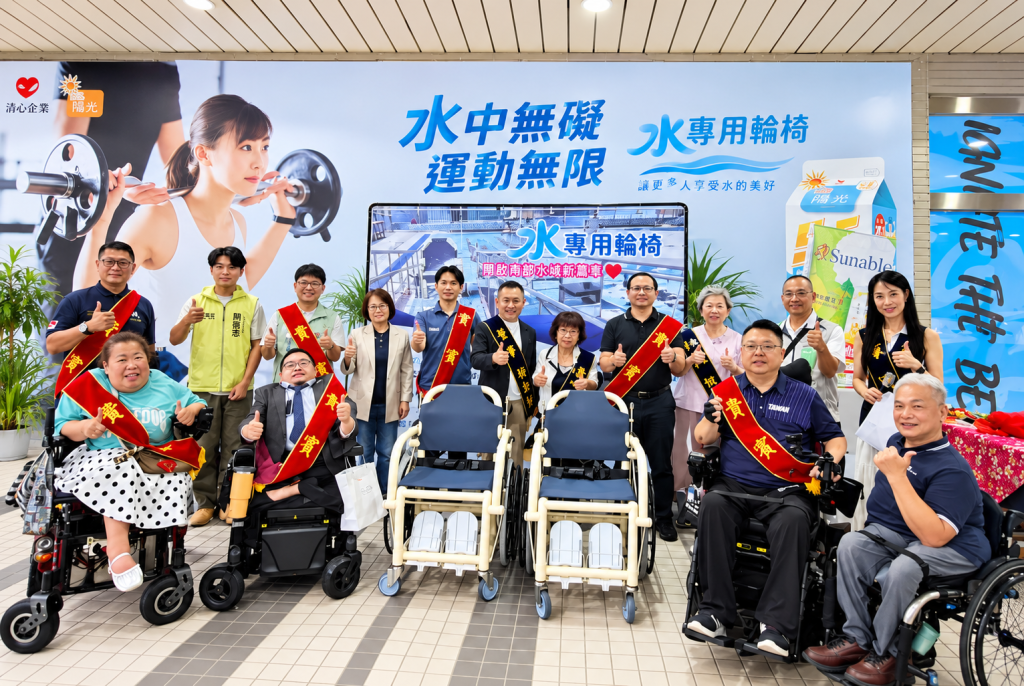
Recently, five Australian-made aquatic wheelchairs made their way to Taiwan.
On paper, it is a story about equipment travelling from one country to another. But look a little closer and it becomes something much more important, a story about people being given greater choice, dignity and freedom to participate in something many of us take for granted.
The journey to the water shouldn’t be the hardest part
For many people living with disability or limited mobility, arriving at an accessible swimming pool doesn’t necessarily mean they can access the water.
There can still be an entire journey between the front door and the pool.
Changing. Showering. Moving through wet areas. Reaching the pool deck. Transferring from one mobility aid to another. And finally, getting into the water.
In Taiwan, disability advocates have been drawing attention to these often-overlooked barriers.
While accessible entrances, toilets and ramps are important, they don’t necessarily address what happens once a person moves beyond them.
Someone may need to remove a brace or their usual mobility equipment before entering the water, leaving them without the means to move independently. A standard facility wheelchair may not be suitable for showers, wet areas or pool water.
And even when a pool has a ramp leading into the water, there is still a fundamental question:
How does the person get to — and down — that ramp?
For some people, the answer has historically involved difficult transfers, significant assistance or even moving from the wheelchair onto the pool edge before entering the water.
That isn’t the experience most of us imagine when we think about going for a swim.
Five wheelchairs – endless possibilities
A collaboration between disability advocates, a charitable foundation and an architectural practice saw five aquatic wheelchairs imported from Australia and donated to the Taipei-based Accessible Resources Promotion Association.
Rather than remaining permanently at one swimming pool, the wheelchairs are intended to be made available to NGOs and organisations promoting accessible aquatic activities across northern, central and southern Taiwan.
That means their journey isn’t finished.
They’ll keep travelling.
And wherever they go, they have the potential to make another person’s journey to the water just a little easier.
An aquatic wheelchair allows a person to move throughout suitable pool environments, including accessible bathrooms, showers and poolside areas. Depending on the facility and the individual’s needs, it can also provide a way to travel directly down an accessible pool ramp and into the water.
Sometimes simple changes are the ones that give something much bigger back. Independence. Choice. Confidence. Dignity.
Making a difference globally
At Para Mobility, we have always believed that good accessibility equipment should quietly do its job in the background.
The equipment shouldn’t be the focus of someone’s day.
The person should be.
- The child experiencing the water.
- The adult returning to swimming.
- The family enjoying an activity together.
- The therapist able to concentrate on therapy rather than a difficult transfer.
- The support worker who can assist someone with greater confidence.
- Or simply the person who wants to go for a swim without their disability turning the journey from the changeroom to the water into an ordeal.
That’s why seeing Para Mobility equipment appearing in communities beyond Australia means so much to our team.
More than being able to get through the door
The advocates behind the Taiwanese initiative describe genuine aquatic accessibility as considering the person’s complete journey, reaching the facility, changing, showering, moving around the pool environment, entering the water and returning safely afterwards.
It’s a philosophy we strongly share.
Real inclusion happens when someone can arrive somewhere and participate with the same sense of welcome, possibility and belonging as the person beside them.
Sometimes achieving that takes major changes to buildings and infrastructure.
Sometimes it takes better staff training and awareness.
And sometimes, it can begin with something as straightforward as having the right wheelchair available beside the pool.
Quietly changing what is possible
There will probably never be a way to count every moment made possible by accessible equipment.
- The swims taken.
- The therapy sessions completed.
- The holidays enjoyed.
- The families who could participate together.
- The support worker who avoided an unnecessary manual transfer.
- Or the person who simply felt a little less different that day.
Para Mobility may have manufactured these wheelchairs in Australia, but from here, the story belongs to the people who use them.
To the organisations in Taiwan working to create more inclusive aquatic environments.
To the people advocating for better access.
And ultimately, to every individual who gets closer to the water.