
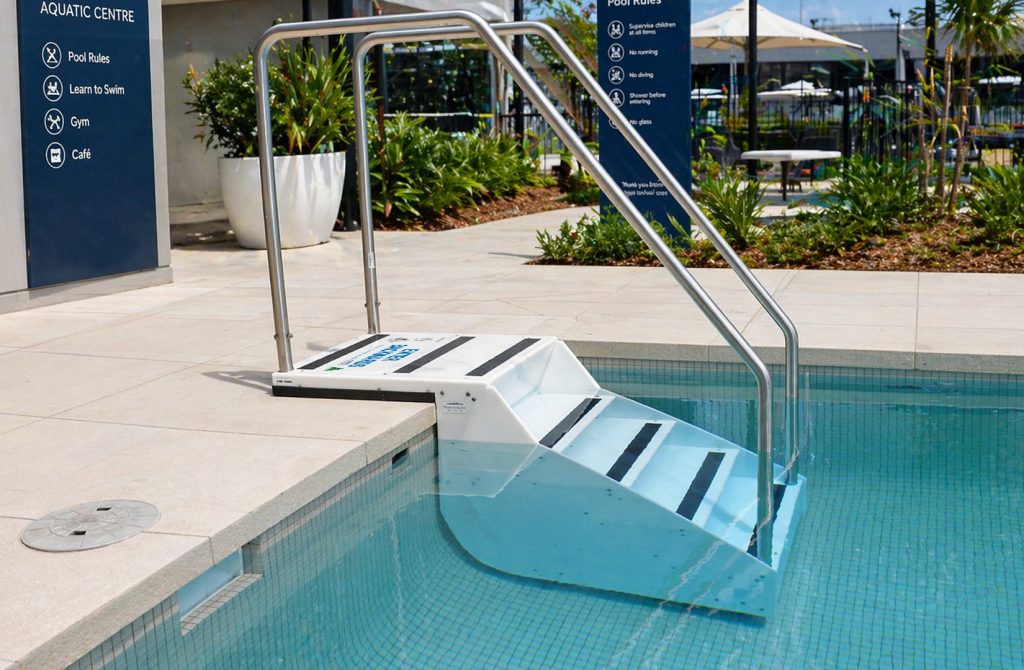
Walk into most pools across Australia and you will see a familiar setup: stainless steel ladder, narrow rails, a few submerged steps. It is standard. It is compliant. It is everywhere.
But it is not inclusive.
For many people, that ladder is not just inconvenient. It is a barrier that quietly decides who gets to participate and who sits on the sidelines.
The assumption problem
Pool ladders are designed around a very specific type of user. Someone with:
- Good upper body strength
- Stable balance
- Joint mobility
- Confidence stepping into depth
That sounds reasonable until you consider how many people do not fit that profile.
This is where the gap appears. Not because ladders are “bad”, but because they are limited.
Who gets left out?
The list is broader than most facilities expect.
- Older Australians
With an ageing population, joint stiffness, reduced strength and balance issues are increasingly common. Steep ladders and narrow steps can feel unstable and unsafe. - People with disability or reduced mobility
For wheelchair users or those with limited lower limb function, ladders are often completely unusable. Even partial mobility challenges can make entry and exit risky. - Injury, rehabilitation and temporary limitations
Not all limitations are permanent. Post-surgery recovery, sports injuries or chronic pain can turn a simple ladder into a major obstacle. - Children, beginners and low-confidence swimmers
Confidence plays a huge role in participation. Ladders can feel intimidating, particularly when stepping down into unknown depth.
The hidden impact on participation
When access is difficult, people make a quiet decision. They opt out.
Not loudly. Not formally. They just stop coming.
For aquatic centres, hotels, community pools and tourism operators, this has real consequences:
- Lower attendance from seniors and families
- Reduced program participation (learn-to-swim, hydrotherapy, rehab)
- Missed tourism bookings from travellers who need accessible facilities
- Increased manual handling risks for staff trying to “help” where infrastructure falls short
Accessibility is not just a compliance box. It directly influences who feels welcome.
Ladders vs real access
A ladder is a single-point solution. It works for some, but fails many.
True access considers:
- Gradual, stable entry
- Independence and dignity
- Minimal reliance on staff assistance
- Safe exit from the water, not just entry
This is where facilities begin to rethink their approach.
What inclusive pool entry actually looks like
It does not require removing ladders entirely. It means adding options.
- Pool steps and graded entry
Wide, stable steps with handrails allow users to enter at their own pace. - Pool access seats
Solutions like the Kingfisher Pool Access Seat provide a controlled, seated entry for users who cannot manage steps or ladders independently. - Pool hoists
Pelican Pool & Spa Hoist systems enable safe transfers into the water without manual lifting, supporting both users and staff. - Aquatic wheelchairs
Pelican Aquatic Wheelchair options allow seamless movement from poolside into the water environment.
These solutions do more than improve access. They change the experience from “assisted” to “independent”.
A simple question worth asking
If your pool only had a ladder, who would you unintentionally exclude?
And just as importantly… How many of those people have already chosen not to come back?
Moving from access to inclusion
Ladders will always have a place. But they should not be the only option.
When facilities expand how people enter the water, something important happens:
- Participation increases
- Confidence grows
- Staff risk decreases
- Communities become more inclusive
And most importantly, more people get to enjoy the water.
Because access is about belonging once you are there.