
Accessibility is not one-size-fits-all.
Every person experiences mobility differently. Some individuals may walk independently but require support over longer distances. Others may use mobility equipment full-time. Some need assistance entering pools or vehicles, while others benefit from solutions that reduce manual handling and improve safety for carers and support teams.
The challenge is not simply providing access. It is providing the right access.
Matching accessibility solutions to individual mobility levels helps create better outcomes, greater independence, improved safety, and more meaningful participation in everyday life.
At Para Mobility, this principle sits at the centre of every solution. The goal is not simply equipment provision. It is helping people access communities, recreation, therapy, transport, and daily experiences in ways that suit their individual needs.
Mobility Needs Exist Across a Spectrum
Mobility requirements can vary significantly between individuals and can also change over time.
Someone recovering from injury may require temporary support. A person living with disability may need equipment tailored to lifelong mobility requirements. Ageing populations may benefit from solutions that maintain confidence and independence while reducing falls risks.
Effective access planning starts by considering:
- Level of independent movement
- Transfer capability
- Upper body strength
- Balance and stability
- Carer or support worker involvement
- Frequency of use
- Environment and destination requirements
- Long-term mobility goals
The right solution supports the person rather than forcing the person to adapt to the equipment.
Supporting Aquatic Access Across Different Mobility Levels
Water-based activity provides enormous benefits.
Exercise, hydrotherapy, recreation, social connection, and improved wellbeing all make aquatic environments valuable spaces for people of all abilities.
However, entering and exiting pools safely can present significant challenges.
Different mobility levels often require different approaches.
Independent Users Seeking Additional Support
Some individuals retain mobility but need assistance with balance, stability, or navigating pool entry points.
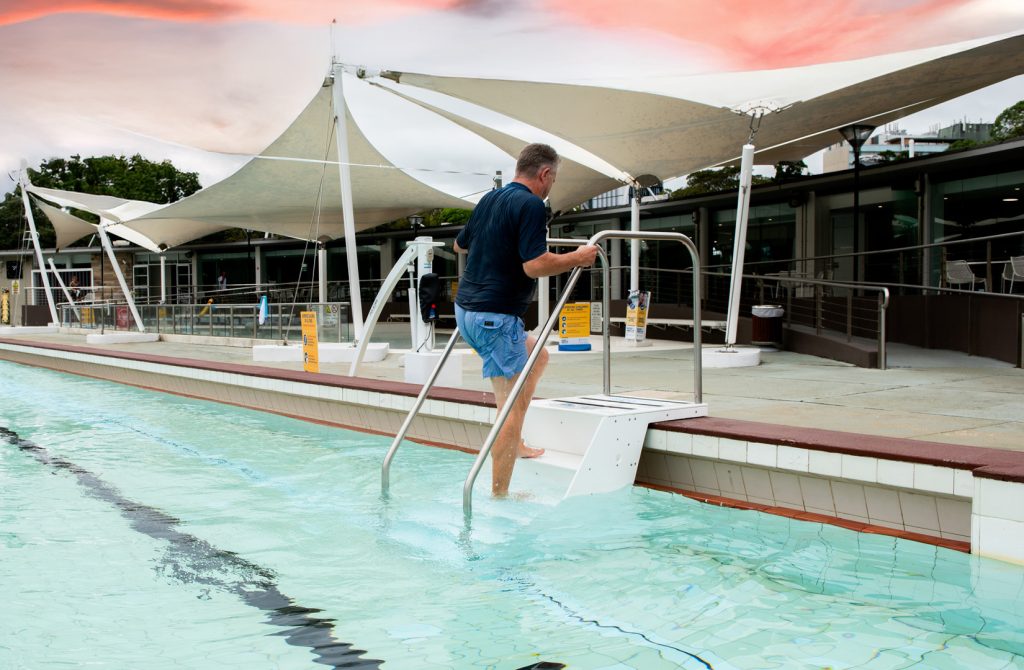
Solutions such as the Kingfisher Pool Access Seat provide an option for users who can independently transfer and operate equipment but require support entering and exiting the water safely.
Compact and user-operated, it helps maintain independence while improving access.
Users Requiring Assisted Transfers
For people with reduced mobility, manual handling risks can become significant.
The Pelican Pool and Spa Hoist supports safer pool access by reducing physical strain for carers and support staff while helping users enter and exit aquatic environments with dignity and confidence.
With options including wheelchairs, floating slings, and supportive seating configurations, solutions can be aligned to individual mobility requirements and facility environments.
The result is greater access to hydrotherapy, recreation, and social participation.
Users Requiring Mobility Equipment in Wet Environments
Mobility requirements do not stop at the pool edge.
The Pelican Aquatic Wheelchair supports movement across wet environments and aquatic settings where conventional mobility equipment may not perform effectively.
Combined with transfer systems and pool access solutions, aquatic wheelchairs help create more complete accessibility pathways.
Matching Vehicle Access to Individual Needs
Transport accessibility plays a critical role in independence.
Not everyone requiring transfer support needs a fully modified wheelchair-accessible vehicle.
The IBIS Wheelchair to Car Access System provides an alternative approach for individuals who can transfer but require assistance moving safely between mobility equipment and standard vehicle seating.
Portable and designed to reduce manual handling requirements, solutions like IBIS can help individuals and families maintain transport independence without necessarily transitioning to larger vehicle modifications.
Matching equipment capability to mobility requirements can improve both practicality and affordability.
Flexible Access for Changing Needs
Mobility requirements are not always static.
Health conditions evolve. Rehabilitation progresses. Functional capacity changes.
Accessibility planning should account for both current requirements and future possibilities.
This may mean selecting solutions that:
- Accommodate changing mobility levels
- Reduce future manual handling risks
- Support long-term participation goals
- Integrate across home, transport, recreation, and community settings
The right accessibility investment supports independence today while adapting for tomorrow.
Independence Looks Different for Everyone
Accessibility is about creating opportunities for participation, choice, confidence, and dignity.
For some people, independence means self-operating a pool access system.
For others, it means reducing reliance on physical lifting from carers.
For families, it may mean safer transport options.
For facilities and organisations, it means creating environments where more people can participate fully.
Matching mobility levels with the right accessibility solutions creates outcomes that extend beyond equipment.
It creates inclusion.
With decades of first hand experience, the team at Para Mobility are available to answer your questions and ensure you are investing in the right equipment to suit your needs. Contact us online or by calling 1300 444 600.